

Le journal Morosko
Fès Zellige: The History, Craft and Geometry of a Moroccan Art
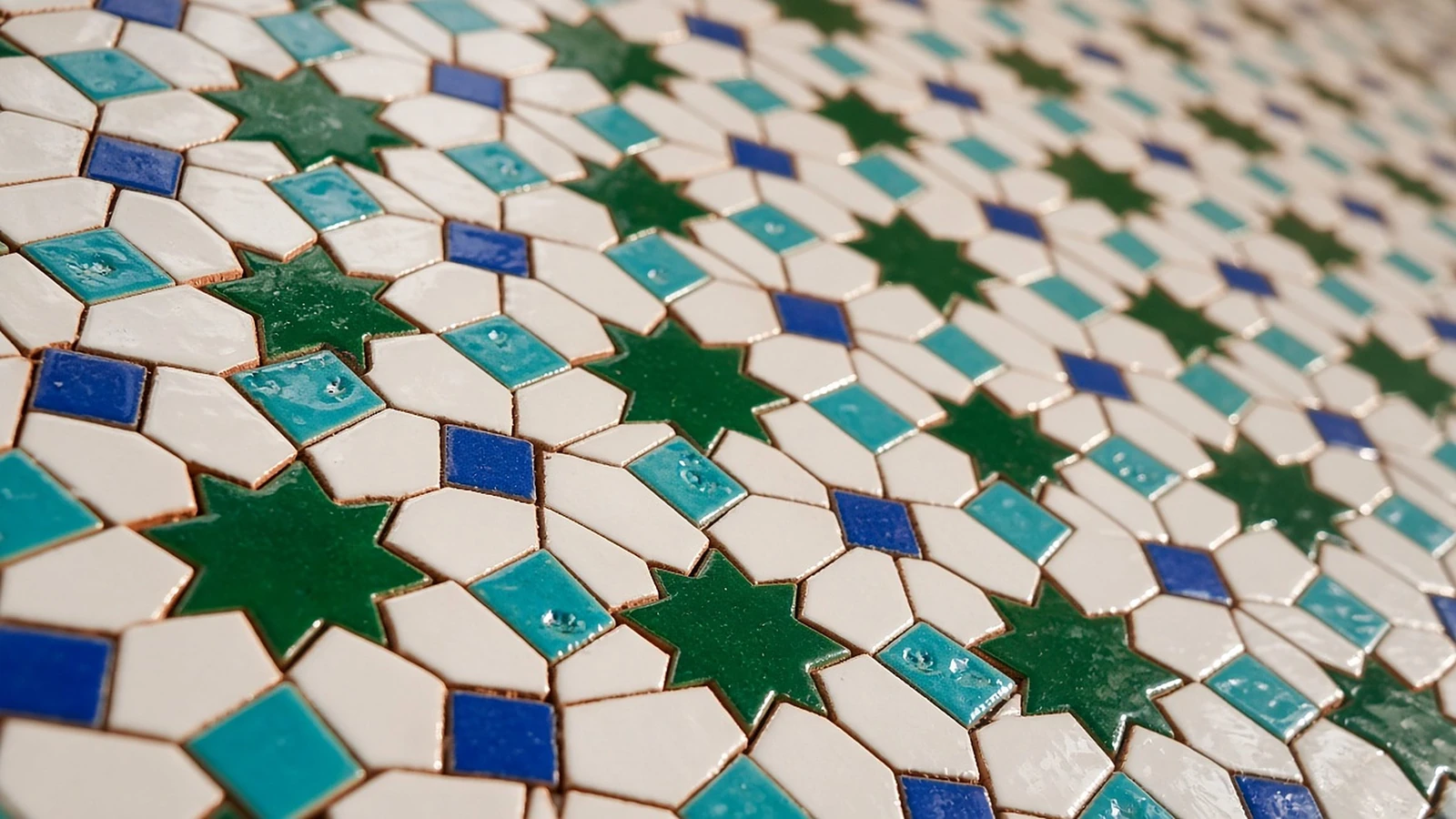
Zellige is a mosaic of glazed terracotta, cut piece by piece by hand and assembled like a puzzle into geometric patterns. Born in the medieval western Islamic world, it reached exceptional refinement in Fès, which remains its main centre of production today.
You see it on the walls of madrasas, around fountains, underfoot in riads. People often admire it without knowing the story it tells. Yet behind every star lies a craft carried by the memory of artisans, and a geometry that eventually caught the attention of physicists. Here is a closer look at an art Fès has kept alive for centuries.
What exactly is zellige?
Zellige (also spelled zellij) is a surface covering made of small fragments of glazed tile, each a single colour, cut by hand and then set side by side. Together, these pieces form pavements, rosettes and stars of striking precision.
The word comes from the Arabic zillīj, linked to the verb zalaja, “to slide”, a nod to the smooth, glassy surface of the tiles. A fun linguistic twist: azulejo, the word for the painted tiles of Spain and Portugal, comes from the same root.
Where does zellige come from? A short history
Origins in the western Islamic world
Historians place the beginnings of tile mosaic in Ifriqiya (present-day Tunisia) and present-day Algeria, between the 10th and 11th centuries. In Morocco, the earliest reliably dated example, according to art historian Jonathan Bloom, adorns the minaret of the Kutubiyya Mosque in Marrakesh, from the mid-12th century: large green and white pieces designed to be read from afar.
The Marinid golden age, with Fès in the spotlight
It was in the 14th century, under the Marinids in Morocco, the Zayyanids in Tlemcen and the Nasrids in Granada, that zellige became the refined art we know. Patterns grew more complex, palettes expanded with yellows, blues and browns, and the pieces became smaller and more numerous.
Fès was then at its height. According to UNESCO, the city flourished in the 13th and 14th centuries under the Marinid dynasty, and most of its key monuments (madrasas, fondouks, palaces, fountains) date from that period. The Bou Inania and al-Attarine madrasas are its showcases: their zellige dadoes rank among the most accomplished geometric compositions of the era.
An art that never faded in Morocco
Elsewhere, tile mosaic fell out of fashion after the 15th century, replaced by painted tiles. In Morocco, by contrast, it carried on and even spread: under the Saadians it covered ever more surfaces, as the Saadian Tombs in Marrakesh show. In the 19th and 20th centuries, artisans developed large geometric rosettes for fountains, arches and columns. Zellige is still one of the hallmarks of Moroccan artistic identity, and Fès remains its most important centre of production. Workshops in other cities generally follow the Fès style, with the notable exception of Tétouan, which developed its own technique.
How is zellige made? The craft step by step
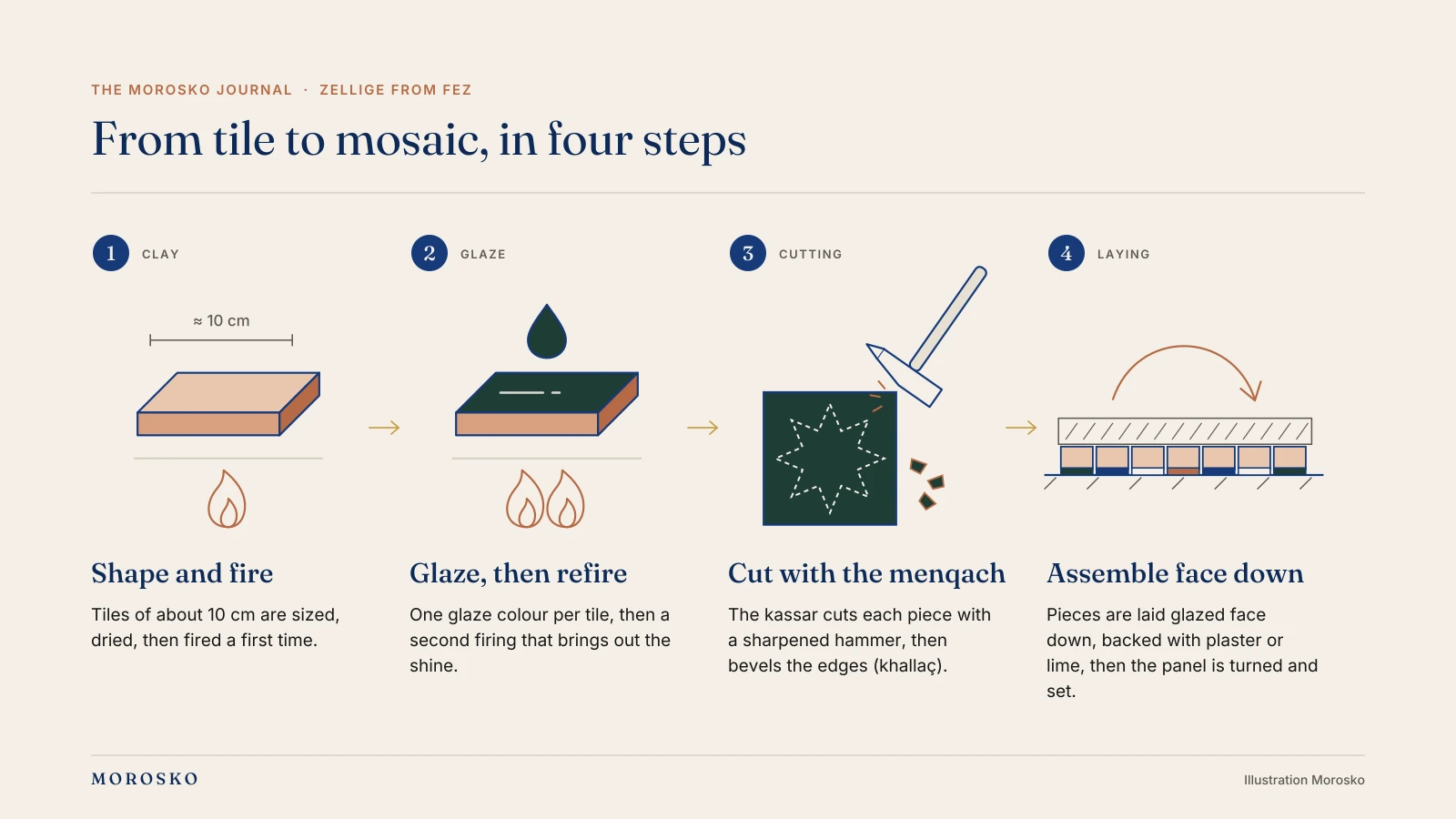
1. Shaping and firing the clay
It all starts with clay, moulded into tiles about ten centimetres across, trimmed to size and dried. A first firing sets the shape of the clay.
2. Glazing, then firing again
The tiles are then glazed, one colour per tile, before a second firing. This double firing, perfected in the Marinid era, gives zellige its glow. Traditional kilns were once fuelled with plant material such as palm fronds or oleander branches.
3. Cutting with the menqach
Next comes the most spectacular step. The cutter, the kassar, breaks each glazed tile into small geometric pieces using a sharp hammer called a menqach (or manqach). The shapes are precise and usually known by heart. A second operation, khallaç, bevels the pieces to even out their edges so they fit together as tightly as possible.
Worth knowing: in Tétouan, the tradition is to cut the pieces before firing. The glaze is harder and more durable, but the colours are less vivid and the pieces fit less tightly than in Fès.
4. Assembling the puzzle… upside down
This is the most surprising gesture to an untrained eye: the pieces are laid glazed side down. The artisan builds the pattern without ever seeing it. Once the design is complete, the back is covered with a thin layer of plaster or lime which, as it dries, binds the pieces into a panel. The panel is then turned over and fixed to the wall with mortar.
Zellige patterns: what geometry lies behind the stars?
Polygons and symmetries
Traditional zellige is built on tilings of polygons: six-, eight-, twelve- or sixteen-pointed stars, lozenges, crosses. In the western Islamic world, Marinid and Nasrid artisans particularly excelled at compositions based on fourfold symmetry, enlarging the base patterns and slipping in ever more complex stars.
What about the golden ratio?
This is the big idea of the post that inspired this article: behind the diversity of styles, one shared geometric language, that of φ, the golden ratio. It deserves some nuance. The golden ratio arises naturally in the geometry of the pentagon and decagon, and so in patterns with fivefold symmetry (ten-pointed stars, for example). These patterns, very common in the rest of the Islamic world, are rarer in the Maghreb. Fès is precisely the exception: the al-Attarine and Bou Inania madrasas hold remarkable examples.
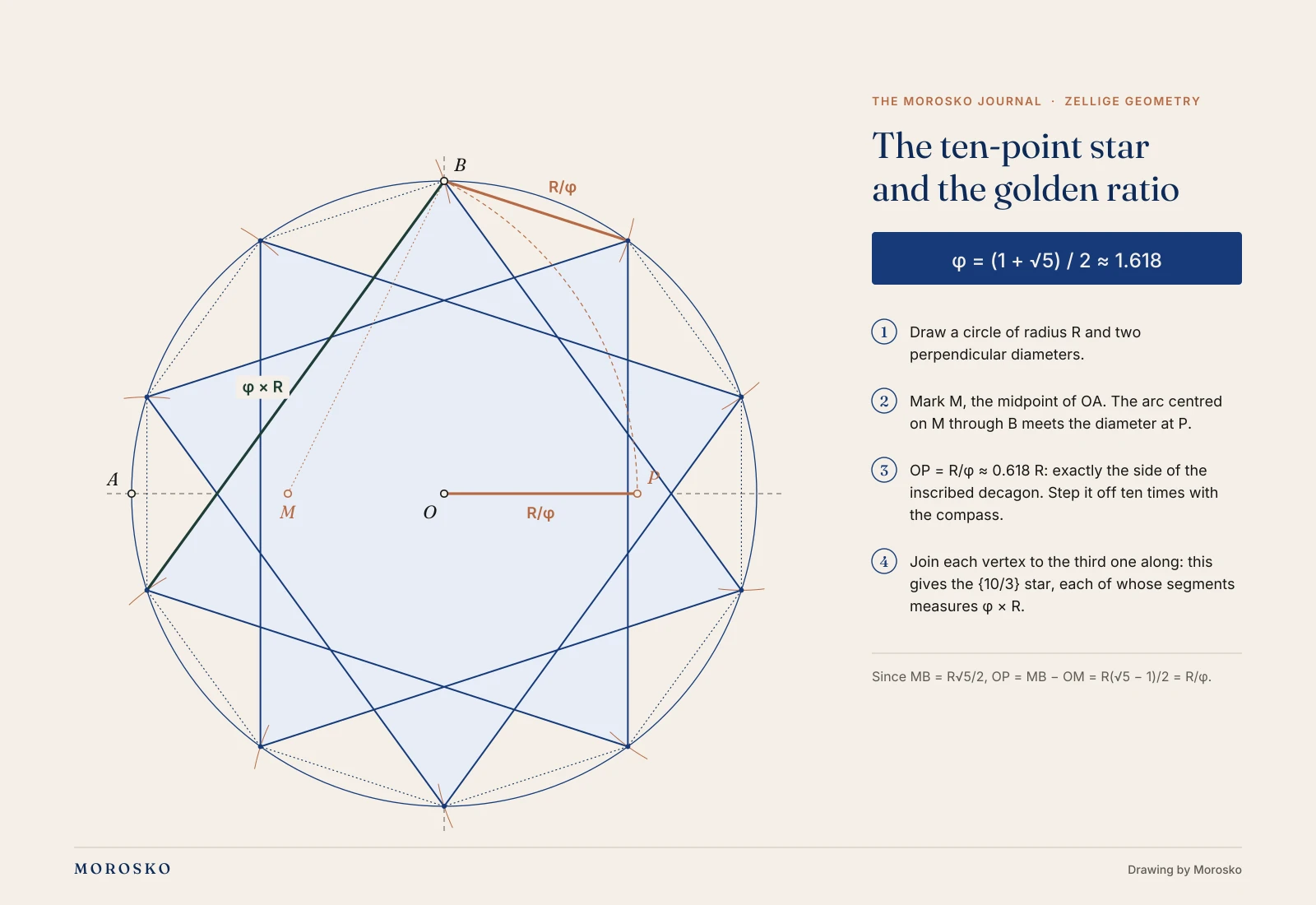
Science has joined the conversation. In 2007, physicists Peter J. Lu and Paul J. Steinhardt showed in the journal Science that some medieval Islamic designs (notably at the Darb-i Imam shrine in Isfahan, dated 1453) follow a quasi-crystalline geometry, centuries before Western mathematicians described it. Their work concerns Persian girih patterns, not Moroccan zellige specifically. But it says something about this shared culture of geometry. And when Dan Shechtman received the 2011 Nobel Prize in Chemistry for discovering quasicrystals, the Royal Swedish Academy of Sciences itself pointed to the mosaics of the Arab world, from the Alhambra to the Darb-i Imam.
The maâlem: memory rather than blueprints
At the heart of this art stands the maâlem, the master craftsman. He designs the patterns, sometimes highly complex, and is generally able to draw and assemble them from memory. The principles of construction have not changed for centuries, and Moroccan artisans still master them today. The shapes to be cut are learned by heart: the knowledge lives in the hand, the eye and the memory.
UNESCO makes the same point about the Medina of Fès: the survival of traditional skills, especially in the crafts of architectural decoration, is one of the site’s major strengths.
How can you spot real handmade zellige?
When faced with a catalogue “zellige”, a few simple cues help tell the difference:
- Pieces, not prints. Real zellige is a mosaic: each colour is a separate piece, cut and set beside the others. Imitations often reproduce the pattern by painting or printing it onto a square tile.
- A thin rim of terracotta. Hammer cutting leaves a narrow border of bare terracotta around the edge of each piece. Look closely: you can see it.
- Bevelled edges. After cutting, each piece is bevelled (khallaç) to even out its edges: a finishing detail that a moulded or printed tile doesn’t have.
- One colour per piece. Each fragment comes from a tile glazed in a single colour: no gradient or pattern within one piece.
- A tight fit. In Fès zellige, cut after firing, the pieces fit more tightly than in the Tétouan tradition.
Fès, a city where skills are handed down
Founded in the 9th century and inscribed on the UNESCO World Heritage List in 1981, the Medina of Fès, described by UNESCO as one of the largest and best-preserved historic cities of the Arab-Muslim world, is no frozen museum. Its workshops keep shaping, cutting and assembling, carrying on the gestures of generations of artisans.
At Morosko, this living heritage inspires us every day. We neither make nor sell zellige, but we share the same conviction: the work of the hand gives objects a soul that nothing can replace. It is in this spirit that Ghali Khomsi designed the ATLAS collection, whose pieces are handmade in Fès by our artisans. And if Moroccan heritage reimagined speaks to you, discover our genderless selham (page in French) too. To choose a Moroccan piece with confidence, read our guide on where to buy Moroccan crafts in France.
Discover the ATLAS collection (page in French): Fès savoir-faire, made to be worn every day.
FAQ: your questions about zellige
What is the difference between zellige and azulejo?
Zellige is a mosaic of glazed pieces cut by hand and assembled; azulejo refers to painted tiles. Yet the word azulejo comes from the Arabic zillīj.
Why is Fès zellige so renowned?
Fès has been a major zellige centre since the Marinid era, and it remains the craft’s main centre of production. Most workshops in other cities follow the Fès style.
What tool is used to cut zellige?
The menqach (or manqach), a small sharp hammer. The edges are then bevelled in a second step called khallaç.
Does zellige contain the golden ratio?
The golden ratio is tied to the geometry of the pentagon and appears in patterns with fivefold symmetry. These are rarer in the Maghreb, but Fès holds fine examples, notably in the al-Attarine and Bou Inania madrasas.
How is zellige installed?
The pieces are assembled face down, bound at the back with a layer of plaster or lime, then the panel is turned over and fixed to the wall with mortar.
Sources
- UNESCO World Heritage Centre: Medina of Fez
- Peter J. Lu and Paul J. Steinhardt, “Decagonal and Quasi-Crystalline Tilings in Medieval Islamic Architecture”, Science, vol. 315, 2007: doi.org/10.1126/science.1135491
- Royal Swedish Academy of Sciences, 2011 Nobel Prize in Chemistry press release
- Jonathan M. Bloom, Architecture of the Islamic West: North Africa and the Iberian Peninsula, 700–1800, Yale University Press, 2020 (cited via Wikipedia)
- Jay Bonner, Islamic Geometric Patterns: Their Historical Development and Traditional Methods of Construction, Springer, 2017 (cited via Wikipedia)
- Wikipedia: Zellij (EN) and Zellige (FR)
Inspiration: Instagram post by @marrakechbestspot.

The ATLAS collection
Pieces handmade in Fès, in a numbered series.
Keep reading

Moroccan Handmade Gift Ideas for Christmas: A Guide to Giving Handmade
The best Moroccan gifts have three things in common: they get used, their origin is clear, and their finish shows the hand that made them. A hooded selham,…
How to Buy Authentic Moroccan Crafts in France (and Online)
There are three main ways to buy Moroccan crafts in France: shops and craft fairs, large online marketplaces, and brands that work directly with workshops in Morocco. Whichever…